Construction Loan Draws
Project
Draw Manager Budget Items
Year
2026
At The Mortgage Office, I worked on improving the Budget Items experience within Draw Manager, a tool used by private lenders to manage construction loan disbursements. Construction lenders use this feature to review project budgets, approve draw requests, and track how loan funds are distributed throughout a project's lifecycle.
Although several enterprise customers had purchased this feature, adoption remained low, with many relying on external platforms and manual processes instead. The goal is to increase adoption by simplifying workflows and reducing friction throughout the draw request experience.
Scope of Work

Problem
Despite purchasing the feature, enterprise customers were not actively using it.
Research uncovered several pain points:
Multi-step workflows required excessive clicking
Users could not edit budget items after creation
Important information was difficult to locate
No ability to leave notes or collaborate
Limited visibility into draw request status
Inability to split payments between multiple payees
Difficulties adding new vendors
UI inconsistencies and bugs created friction

Solution
We focused on high-impact improvements that could be implemented quickly while minimizing disruption to existing systems.
Key improvements included:
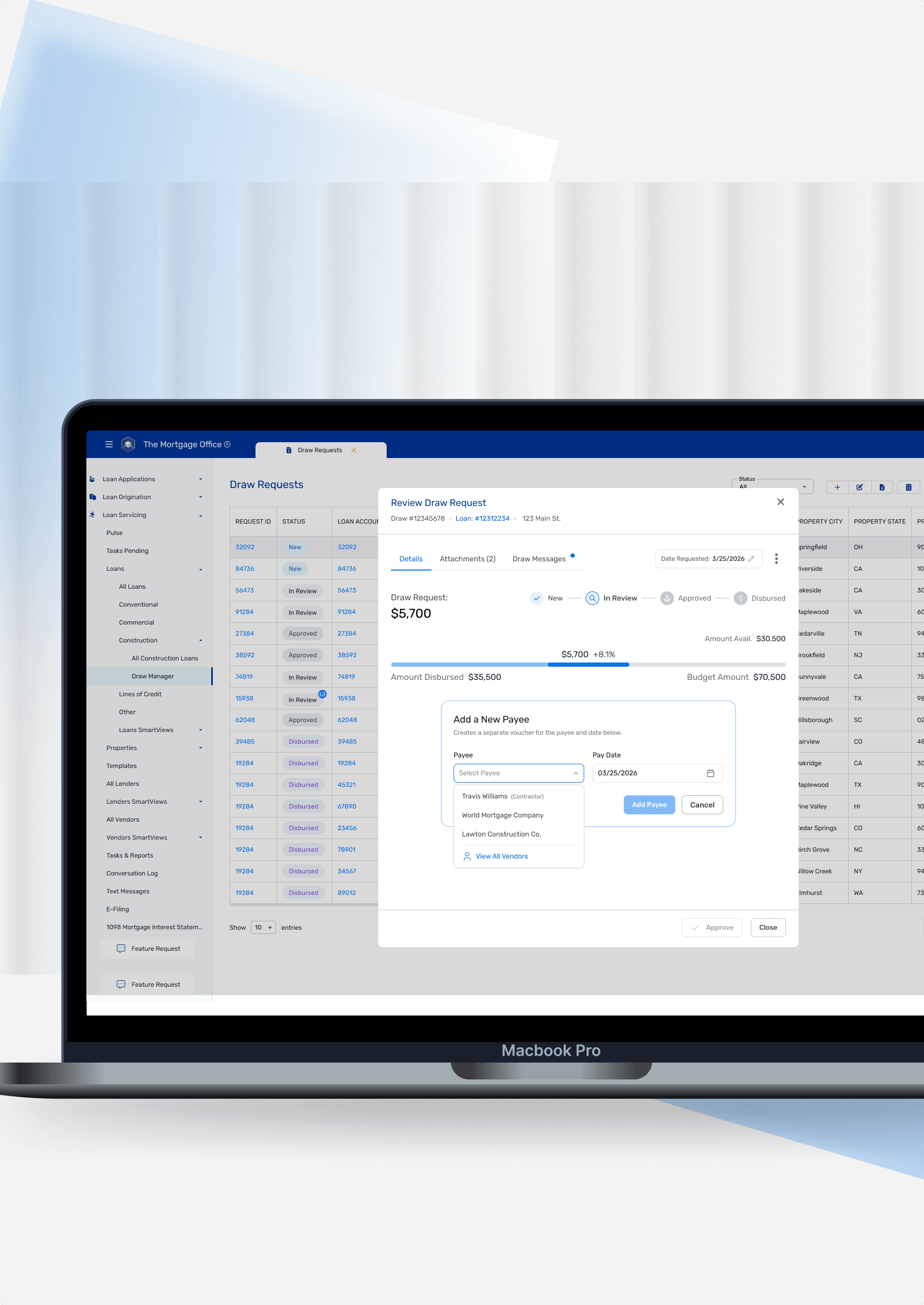
Introducing a notes experience for collaboration
Adding loan status and disbursement progress tracking
Surfacing key dates, including requested and estimated pay dates
Enabling multiple payees and payment splitting
Improving information hierarchy and reducing the need to leave modals
Fixing UI inconsistencies and visual bugs

Constraints & Challenges
Working Within Existing Systems
Engineering bandwidth was limited, so we needed to identify improvements that delivered immediate value without disrupting legacy CSS or requiring significant development effort.
This required balancing:
Customer impact
Engineering feasibility
Technical constraints
Long-term scalability
The guiding question became:
Which improvements would meaningfully increase adoption while remaining lightweight enough to implement?
